

The Bear Den- My Current Studio
Six Design Considerations
8/24/18
My home studio is called “The Bear Den” What’s in a name? Well, we live in a semi-rural neighborhood where, you guessed it, bears are not infrequent visitors. 
It’s also because what I want to come out of my studio should be big and powerful but also playful, gentle and respectful. Bears are all of those things. I struggled over the word “respectful”. I couldn’t find a better choice. Bears are happy to get along with their neighbors and won’t bother you if you don’t bother them. The sad thing about black bears is that they only get into trouble when we, humans, lead them into it. Well enough about bears…for now.
What I’d like to do is give you an overview of the creation and evolution of “The Bear Den” with some side journeys into the specifics and details of some of its unique aspects. I’ll kick it off today with some recollection of the initial thoughts and planning.
If you believe in lucky numbers, this is my seventh studio, it might not be my last, but it will probably end up being my biggest and most extensive. Like several of my most recent, I was fortunate enough to have the ability to scope out a house with an eye towards potential studio space. I never expect to have the “perfect” space, but I always look to minimize the constraints.
When I started thinking about this studio here are six things that were on my radar screen. You may find them helpful too:
1. Room(s) size
There are three reasons to consider room size and shape:
-
- Microphone based recording
- Monitor based mixing and mastering
- Workflow ergonomics
- It doesn’t have to be big, but it needs to be able to hold the things you want in it. Some people’s creativity appreciates cozy, eclectic (cluttered) spaces, others like open, stark environments. Each style has acoustic implications and sonic treatment requirements.
2. Room shape
Parallel walls cause problems. But very few of us have spaces that cooperate. Acoustic treatment is the answer. More on that in a future blog.
3. Wall, floor and ceiling construction
The harder the material the more echo and reverb propagation. Can be a large problem or an enhancement. However, even when it’s an enhancement, if untreated, you only get one room sound. My preference is to minimize the room sound and have the flexibility to adjust in software. This wasn’t always the case, but now with Impulse Responses (IR) you can have any room you want.
4. Room location
Proximity to the dwelling’s mechanical systems (furnace, water heaters, refigerators, elevators etc.) Unfortunately, my space is close to our furnace, water heaters and well pump. Recording acoustic guitar and vocals in the winter time requires patience and pauses. Fortunately, the on /off cycles have breaks. Extra wall installation can help, but I haven’t felt the extra effort / expense was worth the time and money. Besides, it helps me learn to manage my impatience.
Distance from where your partner / roomates hang out is a big plus. My best studios were at the other end of our home from our bedroom. I could work at all hours without disturbing Ginger’s sleep (or sanity).
5. Network environment
Power availability is critical. Multiple circuits are a big plus. Conditioning is helpful as is monitoring. Cables and cabling needs to be organized and managed. Interference and noise will require some time and effort but is doable, particularly in these days of wired and wireless networking. I’ll get into this in more detail in the future.
6. Studio Strategy
It’s a good idea to thing about how you’re going to use the studio before you start detailed planning. I wanted the ability to do a lot of things, both as a solo performer / engineer as well as with a small group of collaborators. A top priority was the ability to capture live acoustic sound with microphones with keyboards, stringed instruments, vocals, drums and percussion. I also knew I would work “direct into the board” as well. I had enough space so luckily I could build into the design the capability to
accomodate three or four live performers.
Here’s the space I had to work with:
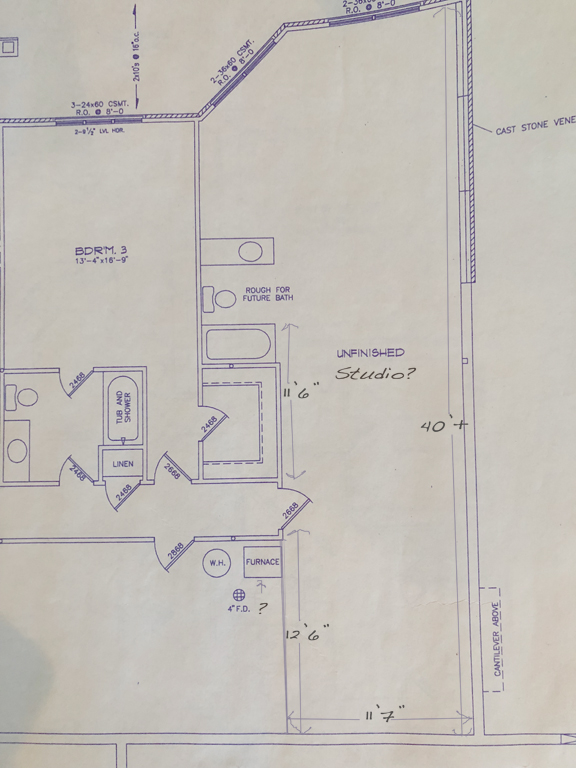
Yep, not your traditional space. Plenty of room, but as I mentioned earlier, some constraints that needed to be managed. My original plan called out three sections: a “Control Room” with keyboard rack, Guitar and Vocal space, and a Drum/Percussion space.
My initial plan:
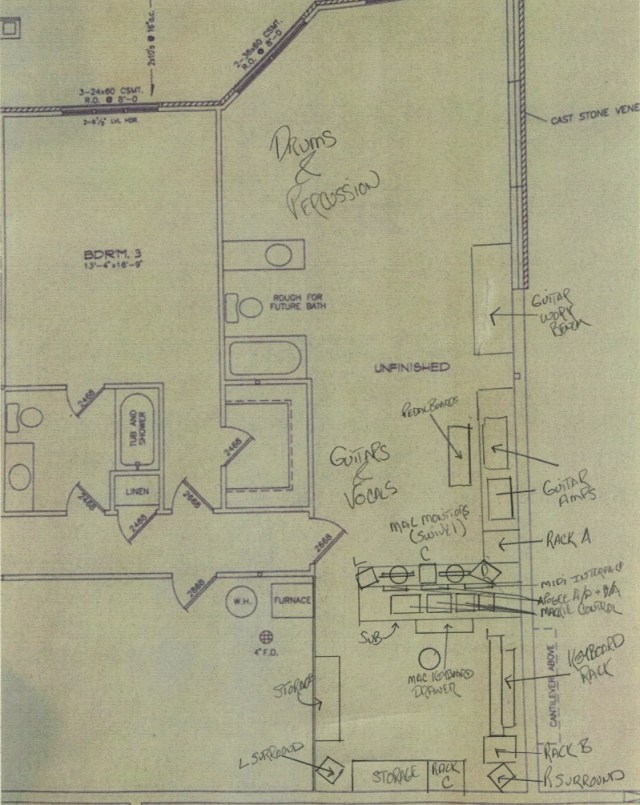
As you’ll see, though a lot of this is still there, it’s not where I ended up. As General Eisenhower said, “Plans are nothing, planning is everything”.
Next: “Initial construction” Designing and building the required furniture to support my workflow and physical constraints (read that as ”arthritic spine.”)
 Miracle Peak Media